Where to advertise a property in Spain: a guide for foreign owners
You bought a place on the coast years ago and now you want to sell it, or let it. You are not an estate agent, and the advice you find is either about the American market or written in Spanish for Spaniards. This guide is the missing middle: which Spanish portals exist, which of them will accept an advert from you, and what each one refuses to allow inside the text of that advert.

Where you should advertise depends on two things, and neither of them is which portal is “best”: who you are — a private owner or a professional — and what you are offering — a sale, a long-term let or a holiday let. Find yourself below.
You are selling your own home
Start with idealista, where a private seller’s first two adverts are free, and add Fotocasa and Habitaclia, which are free for private sellers. yaencontre is free up to four properties and translates the advert itself.
Kyero is not an option for you: it only publishes adverts from agencies.
You are letting it as a holiday rental
The big sale portals will not take it. Go to Rentalia, which accepts private owners and also pushes your advert out to idealista and yaencontre, and consider Milanuncios and Wallapop.
Vrbo, Airbnb and Booking.com are a different category: booking platforms that charge a commission per booking.
You run a small agency
Everything above applies, and one door opens: Kyero works with professionals only, and it is the portal foreign buyers look at.
The cost is that every portal has its own rules about the advert text, and you are not publishing one advert — you are publishing a whole portfolio.
How the Spanish market splits
The mapSpain does not have one dominant property site with everything on it. It has three groups of destinations that barely overlap, and the commonest mistake a foreign owner makes is to treat them as one list: the national portals for sale and long-term rental, most of them open to private advertisers; the international side, aimed at buyers searching from abroad and mostly closed to private sellers; and holiday rental, a separate world with separate sites, because the big sale portals do not accept short-term lets at all.
That last point catches people out constantly: idealista sends holiday lets to Rentalia, Fotocasa excludes them by an express rule, Habitaclia applies the same clause as its group partner, and on yaencontre an advertiser cannot publish one because its holiday section is fed only from Rentalia.
National portals: where a private owner can publish
Private ownersThese are the sites where you can create an account yourself and put your home up for sale or long-term rental. They are listed by what they are, not in any order of merit: most owners end up on more than one.
idealista takes both private sellers and professionals. Two of its rules matter from the beginning: contact details and the price belong in the fields the portal gives you for them, never inside the text of the advert; and holiday rental is not published here, because the portal itself redirects it to Rentalia, part of the same group. A private seller’s first two adverts are free; a third property, duplicate adverts, high-value sales and high-end rentals move onto a paid footing, with the thresholds published on the portal.
Fotocasa is free for private sellers. It asks for the final price of the property, and it has one little-known rule that affects foreign owners more than anyone: if you write the advert in a foreign language, it must be accompanied by its translation into the co-official language. Worth reading twice if your plan was to publish in English and leave it there.
Habitaclia belongs to the same group as Fotocasa and publishes the same rules — also free for private sellers, same co-official language requirement. The text you prepare for Fotocasa works here unchanged.
yaencontre is part of the idealista group. It is free up to four properties and charges from the fifth, with the rate on the portal. Its rules about the description are among the strictest of any Spanish portal: no contact details, no link to your own website, no block capitals, and it requires the exact price. In exchange it does something no other national portal does — it translates the advert itself into English, French, Italian, German and Catalan.
Milanuncios is a general classifieds site whose property section accepts sale, long-term rental and holiday rental. One property per advert, contact details only in its own fields, no block capitals. From the third advert onwards it requires its professional tool, which is paid.
Wallapop has a real property category and private advertisers use it, including for holiday lets. One property per advert. It does not publish rules about the description text, but the standard the other portals ask for — contact details in their own fields, a text that reads properly — works in your favour here too. Advertising is free for up to two properties at a time; beyond that, its paid professional tool.
The international side: Kyero, and what to do if you are not an agency
InternationalIf you have searched for Spanish property in English yourself, you have almost certainly landed on Kyero. It is built around the buyer looking for a Spanish home from abroad, and for a British, Dutch or German buyer it is often the first place they look.
Here is the part that surprises nearly every private owner: Kyero only publishes adverts from professionals. It does not accept private sellers, whatever your buyer’s nationality. The route onto Kyero is an estate agency that works with the portal.
So if the portal your buyer uses is closed to you, how do you reach that buyer? Not through a secret international site — through the national portals, in your buyer’s language. Foreign buyers search where the properties are, and what decides whether they stop on your advert is whether they can read it.
Holiday rental: a different map
Holiday letsIf you let your Spanish property to holidaymakers, forget the list above and start again: the four big general portals do not take holiday lets. What is left divides into two kinds of site, and the difference matters for how you get paid.
Rentalia is the specialist classified portal, part of the idealista group, and it accepts both private owners and agencies. It declares no length limit on the text, although it also asks for a separate short description alongside the long one. It publishes in seven languages, with translation of the advert offered as a paid extra. And it distributes adverts to idealista and yaencontre, so publishing here puts you in those two shop windows as well — which is, in a roundabout way, how a holiday let reaches the audience of the portal that would not accept it directly. On cost, the model is a free trial for new advertisers with a single advert, and after that either a commission per booking or a subscription; check the current figures on the portal.
Milanuncios and Wallapop both accept holiday rental too — Milanuncios with its own section in its published rules, Wallapop with a specific category. Same conditions as for sale: one property per advert, and on Milanuncios contact details only in its own fields and no block capitals.
Vrbo, Airbnb and Booking.com are booking platforms rather than classified portals, and they want the text written differently. Vrbo, part of the Expedia group, asks for a description of between 400 and 10,000 characters and a headline of 20 to 40. Airbnb has rules very much its own: a short title, the voice of a host rather than an advertiser, its own sections, and contact details not allowed — a text written for a classic portal does not fit here as it stands. On Booking.com the description is generated by the site itself from the data you fill in, with only typo corrections allowed. All three charge a commission per booking rather than a listing fee; the rate varies, so check it on each one.
What each portal keeps out of the advert text
Advert textThis is the part a foreign owner cannot guess, and it is where the expensive mistakes live. Every portal publishes its own rules about what may appear inside the description, and they are not the same from one site to the next. The table below is not a ranking — it is a checklist.
The table scrolls sideways →
| Portal | Who can publish | What it keeps out of the advert text |
|---|---|---|
| idealista | Private sellers and professionals. The first two adverts are free | Contact details and the price, outside the text and in its own fields |
| Fotocasa | Free for private sellers | Requires the final price to be stated; if the text is written in a foreign language, it also asks for a version in the co-official language |
| Habitaclia | Free for private sellers | Same group and same rules as Fotocasa |
| Kyero | Agencies only, no private sellers | Block capitals. Its automatic import overwrites anything you edit by hand |
| Milanuncios | Private sellers; from the third advert on, a paid tool | Contact details outside the text, and block capitals. One property per advert |
| yaencontre | Free up to 4 properties | Contact details, your own website and block capitals. Requires the exact price |
| Wallapop | Private sellers; 2 properties at a time on the free plan | Publishes no text rules. One property per advert |
| Rentalia | Private sellers and agencies, holiday rental only | No length limit, but it also asks for a separate short description |
Putting a phone number or an email address inside the description is the most common breach and the worst punished. idealista’s published penalty is the loss of all of the advertiser’s positioning points and removal from the alerts for up to 30 days — and it applies that to all of their adverts, not only to the one that broke the rule. Milanuncios and yaencontre carry the same prohibition, and yaencontre also keeps your own website out of the text.
The safe rule for an owner advertising on several sites at once: keep contact details out of the description everywhere, and put them in the fields the portal gives you. You lose nothing by it, and the portals that ban it will not warn you first.
The second rule that gets adverts penalised is block capitals. WRITING THE ADVERT LIKE THIS is expressly prohibited on Kyero, Milanuncios and yaencontre. And where it is not prohibited it does not help either: it does not read better, it reads worse.
Where not to waste your time
AggregatorsTrovit, Mitula, Nestoria, Nuroa and Globaliza — and in holiday rental Holidu, HomeToGo and Hundredrooms — are not places where you publish. They are aggregators and metasearch engines: they collect adverts from other sites rather than accepting adverts of their own. There is no sign-up form to find. Publish where advertisers are accepted, and the aggregators pick your advert up from there.
What changes when the owner is foreign
Foreign ownersEverything above applies to any owner in Spain. Two things change when the owner is you.
The first is the language of the advert, which is not a detail. In 2025 foreign buyers signed 97,480 home purchases in Spain, the highest figure recorded by the Colegio de Registradores. In the province of Alicante, 43.29% of the year’s transactions were made by foreigners — the highest share of any Spanish province — across 23,112 transactions. Nationally, the nationalities buying most are British, German, Dutch, Moroccan, Romanian and French. If your property is on the Mediterranean coast or the islands, there is a real chance the person who buys it does not read Spanish comfortably.
That cuts both ways. Writing the advert only in English does not open the market up — it closes off the Spanish buyer, who is still the majority almost everywhere, and on Fotocasa it runs straight into the co-official language rule. Writing it only in Spanish leaves the foreign buyer reading your home through a machine translation, which is exactly the experience you had when you bought it. The workable answer is to have the property described properly in both.
The second is who you are talking to. A Spanish buyer reading a listing knows the neighbourhood. A foreign buyer does not, and needs different facts: how far to the airport, whether the community fees include the pool, which floor and whether there is a lift, whether the beach is walkable or a drive. None of that is spin — it is the same house, described for someone who has never stood in that street. It is also what a foreign buyer emails to ask about, one message at a time, if the advert leaves it out.
If you run a small agency in Spain
AgenciesAll of the above applies to you, with two differences. The first opens a door: Kyero works with professionals only, so for you it is genuinely an option, and it is the one the foreign buyer is looking at. The second complicates your week: each portal has its own rules, and you are not publishing one advert but a whole portfolio.
The quick way out is to paste the same text everywhere, and it shows: the adverts end up resembling each other more than the houses do. You do not have to write every property seven times, but it is worth deciding once what goes on which portal — the table above works as a cheat sheet — and having a routine for adapting the text to each site’s rules.
Where BrikData fits, and where it does not
Our toolThe tedious part is not choosing the portals. It is that the same property has to be written differently for each one: contact details out of the text here, an exact price there, a short description alongside the long one somewhere else, and on social media the opposite of all of it, because there are no structured fields and the price has to go in the text itself.
BrikData does that part: you enter the property’s details once and it returns six finished texts in one run, each with the format of its destination, across the portals in this guide and three social networks, in five languages. It is not essential — a good advert can be written by hand — but it saves writing the same house six times. There is a free plan and it does not ask for a card.
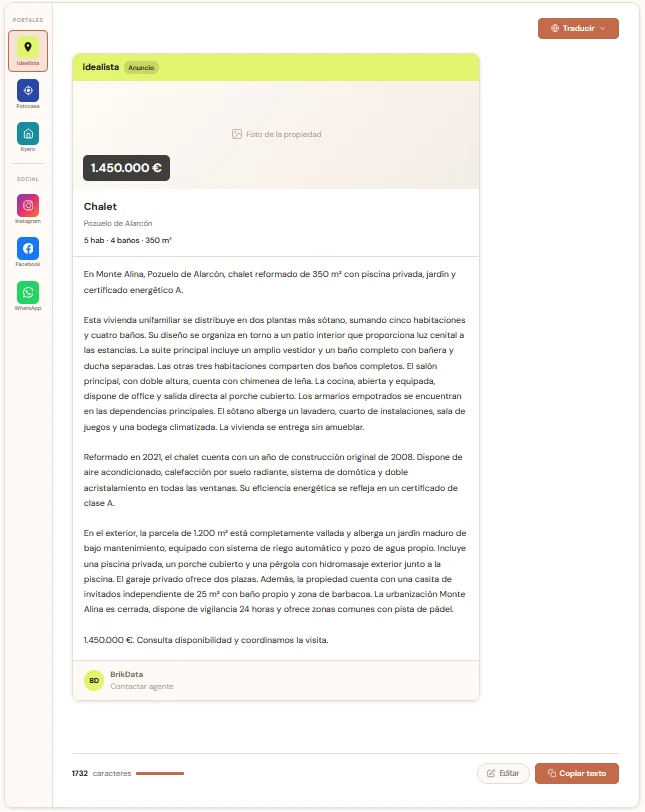
Two limitations, plainly. It does not publish for you: you paste the texts into each portal yourself. And the application itself is in Spanish, even though it writes in English, German, French and Dutch.
Frequently asked questions
FAQCan I advertise my Spanish property myself, without an estate agent?
Yes. The main Spanish portals accept private advertisers directly: idealista takes private sellers and professionals, Fotocasa and Habitaclia are free for private sellers, yaencontre is free up to four properties, and Milanuncios and Wallapop have property categories open to private advertisers. The exception is Kyero, which only publishes adverts from agencies.
Which Spanish property portals are free for a private seller?
For one home, most of them. On idealista a private seller’s first two adverts are free. Fotocasa and Habitaclia are free for private sellers. yaencontre is free up to four properties and charges from the fifth. Wallapop is free for up to two properties at a time. Milanuncios requires its paid professional tool from the third advert on. Beyond those thresholds, check the current figure on the portal itself.
Can I list on Kyero as a private owner?
No. Kyero only publishes adverts from professionals, so a private owner cannot open an account and advertise there. This surprises many foreign owners, because Kyero is exactly where English-speaking buyers tend to look for Spanish property. The way onto it is through an estate agency that works with the portal. Selling privately, you reach the same buyers through the national portals, in their language.
Can I write my Spanish property advert in English only?
Not everywhere. Fotocasa is the one to know about before you publish: if the advert text is written in a foreign language, it also asks for a version in the co-official language, and Habitaclia publishes the same rule. yaencontre takes a different approach and translates the advert itself into English, French, Italian, German and Catalan.
Can I put my phone number or email address in the description?
Keep contact details out of the description text on every portal, and put them in the fields the portal gives you. idealista, Milanuncios and yaencontre all keep contact information out of the advert text, and yaencontre keeps your own website out of it too. idealista’s published penalty is the loss of all the advertiser’s positioning points and removal from the alerts for up to 30 days, applied to all of that advertiser’s adverts and not only the one that broke the rule.
Where do I advertise a holiday rental in Spain?
Not on the big sale portals, because they do not take holiday lets. Rentalia is the specialist option that accepts private owners and agencies, publishes in several languages and pushes its adverts out to idealista and yaencontre as well. Milanuncios has a section for it in its own rules and Wallapop a specific category. Vrbo, Airbnb and Booking.com are booking platforms and take a commission per booking, so check the current rate on each one.
Does idealista publish holiday rentals?
No. idealista sends holiday lets to Rentalia, which is part of the same group. Fotocasa excludes holiday rental by an express rule and Habitaclia, in the same group, applies the same clause. On yaencontre an advertiser cannot publish one either, because its holiday section is fed only from Rentalia.
Are Trovit, Mitula and Nestoria worth listing on?
You cannot list on them, so there is nothing to weigh up. Trovit, Mitula, Nestoria, Nuroa and Globaliza are aggregators and metasearch sites, and in holiday rental Holidu, HomeToGo and Hundredrooms work the same way: they collect adverts already published elsewhere. Publish on the portals that accept advertisers and the aggregators pick the advert up from there.
Last updated: 26 August 2026.
Sources
- Portal rules and eligibility — each portal’s own published terms, help pages and advertiser conditions: idealista, Fotocasa, Habitaclia, Kyero, Milanuncios, yaencontre, Wallapop and Rentalia. Read on 15 August 2026, with the remaining details confirmed in August 2026.
- Holiday rental platforms — the published conditions and help pages of Vrbo, Airbnb and Booking.com, August 2026.
- Foreign purchase figures — Colegio de Registradores, Anuario Inmobiliario 2025 (Estadística Registral Inmobiliaria), 2025 close.
Fees are the part that changes: portals revise them periodically, so this guide describes the model rather than quoting a price. Check the current figure on the portal itself before you decide.